

For decades, the standard corporate website has functioned as little more than a digital brochure. It features a static “About Us” page, a rigid list of services, a few blog posts, and a contact form hoping for a submission. It forces visitors to do all the heavy lifting—navigating menus, hunting through search bars, and piecing together information to find out if the company can actually solve their problem. In 2026, user expectations have shifted dramatically. We are living in an era where consumers are accustomed to instant, conversational, and highly personalized responses. A static, unresponsive brochure site no longer cuts it. The future of user experience lies in integrating native AI assistance directly into the core fabric of your website design.
This isn’t about slapping a generic, third-party support widget into the bottom-right corner of your screen. It is about building an adaptive interface where an intelligent assistant is natively aware of your content, your products, and your user’s unique intent.
When executed correctly through forward-thinking Indianapolis web design, native AI transforms your site from a passive storefront into an active, 24/7 sales and support powerhouse.
What is “Native” AI Assistance?
Before looking at implementation, it is vital to define what native actually means in modern web design.
A traditional chatbot is a disconnected add-on. It lives in an isolated iframe, has a generic design, and usually relies on basic “if-then” logic trees. If a user asks a question slightly outside its scripted parameters, the bot breaks, frustrating the visitor.
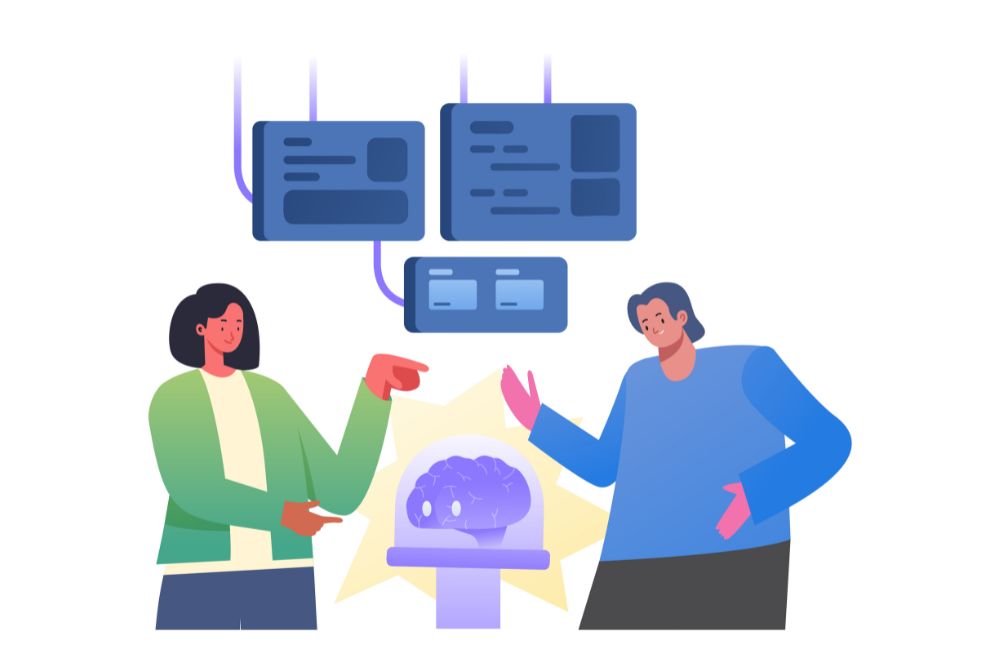
Native AI assistance, by contrast, is deeply woven into your Content Management System (CMS) and your front-end user interface (UI). It leverages advanced Large Language Models (LLMs) via secure APIs and uses Retrieval-Augmented Generation (RAG) to study your entire website’s database in real time.
A native assistant understands the context of the exact page the user is viewing. It matches your brand’s unique design system, fonts, and colors perfectly. It doesn’t feel like an intrusion; it feels like an intuitive feature of the user interface.
How Integrating Native AI Assistance Can Be Leveraged Throughout the Entire Website
 To unlock the true power of an AI assistant, think beyond standard customer support. When an intelligent agent is integrated natively, it can serve distinct, high-value functions across every section of your web ecosystem:
1. The Dynamic Homepage Concierge
When a visitor lands on your homepage, they are looking for a starting point. Instead of forcing them to click through layered dropdown menus, a prominent native AI assistant can act as a digital concierge. A user can type, “I’m a small business owner looking for local SEO help; where should I start?” The assistant instantly delivers a concise summary of your specific services and provides direct, clickable internal links to the exact pages they need.
2. The Interactive Product Expert (E-Commerce & Service Pages)
On a product or service landing page, friction is the ultimate conversion killer. If a user is confused about dimensions, compatibility, or pricing tiers, they will bounce. A native AI assistant embedded on these pages can act as a highly trained specialist. For instance, on an industrial manufacturing site, a buyer could ask, “Does this specific pump housing pass WCAG compliance standards and handle chemical heat up to 180°C?” The AI checks the underlying technical documentation and provides an immediate answer, keeping the sales momentum alive.
3. The Smart Blog and Knowledge Base Navigator
If your website features dozens of educational resources, case studies, or whitepapers, it is easy for older, high-value content to get buried. A native AI assistant can synthesize this data on demand. Instead of scrolling through chronological blog pages, a user can ask, “Summarize your top three case studies regarding conversion rate optimization.” The AI pulls the data, generates the summary, and links out to the original articles for verification.
4. The Friction-Free Lead Qualifier
Standard contact forms are boring, and users hate filling out endless fields. Native AI can turn form completion into a natural conversation. The assistant can gather project details, qualify the lead based on budget or timeline, and seamlessly book a discovery call on your team’s calendar via API—all within the chat interface.
The Core Advantages of a Custom WordPress Integration
Rather than relying on closed, restrictive third-party chat platforms that charge heavy monthly subscription fees based on message volume, leveraging a customized integration within WordPress offers significant operational advantages:
Complete Data Privacy and Sovereignty: Building your AI assistant directly into your WordPress framework means your corporate data stays securely within your infrastructure. You dictate exactly how customer conversations are logged, stored, or cleared, ensuring strict adherence to modern data privacy standards.
 “Hallucinations” via Controlled Guardrails: By using proprietary developer tools to connect your WordPress database directly to a Large Language Model via API, you can ground the AI using your exact site content. You hold complete control over the system prompts, instructing the AI to politely decline answering questions outside the scope of your products, preventing embarrassing or inaccurate responses.
Unified Brand Continuity: A native integration gives you absolute control over the User Interface (UI). The chat windows, slide-out panels, and typography match your custom theme variables exactly. The AI helper looks and feels like a natural element of your design architecture, not a jarring, third-party plugin pasted onto the screen.
UI/UX Best Practice for 2026: Lead with capability transparency. Never try to trick your users into thinking they are chatting with a real human being. Clearly label the interface as your “AI Assistant” and provide 2–3 clickable “Quick Reply” suggestion chips to show users exactly what kinds of questions the bot is trained to handle.
Master Evolving Web Interfaces and Integrating Native AI Assistance with NEXTFLY®
Moving away from the traditional, static “brochure” website layout requires a blend of advanced software engineering, conversion rate optimization, and intuitive interface design. If your AI integration is clunky, slow, or disconnected from the rest of your pages, it will drive users away rather than draw them in.
As a veteran Indianapolis web design firm, NEXTFLY is built to guide your business through this digital evolution. We construct highly responsive, modern, and accessible WordPress sites engineered for both human eyes and AI search crawlers.
Our team doesn’t just build beautiful layouts; we build the technical, secure API frameworks required for integrating native AI assistance into your website interface. We make sure your AI assistant is lightning-fast, beautifully designed, and thoroughly trained on your company’s data so it converts clicks into clients seamlessly.
Don’t let your business get left behind with a static website from the last decade. Contact NEXTFLY today, and let’s design an intelligent, adaptive digital presence that sets you apart from the competition.